Feeling nostalgic this afternoon. Click on the link below:
Nice tune
Check it out.
Our history encompases long, long ago but the land is not far away. It is New Mexico
Wednesday, January 9, 2013


Tuesday, January 8, 2013
Tome, New Mexico Area Map
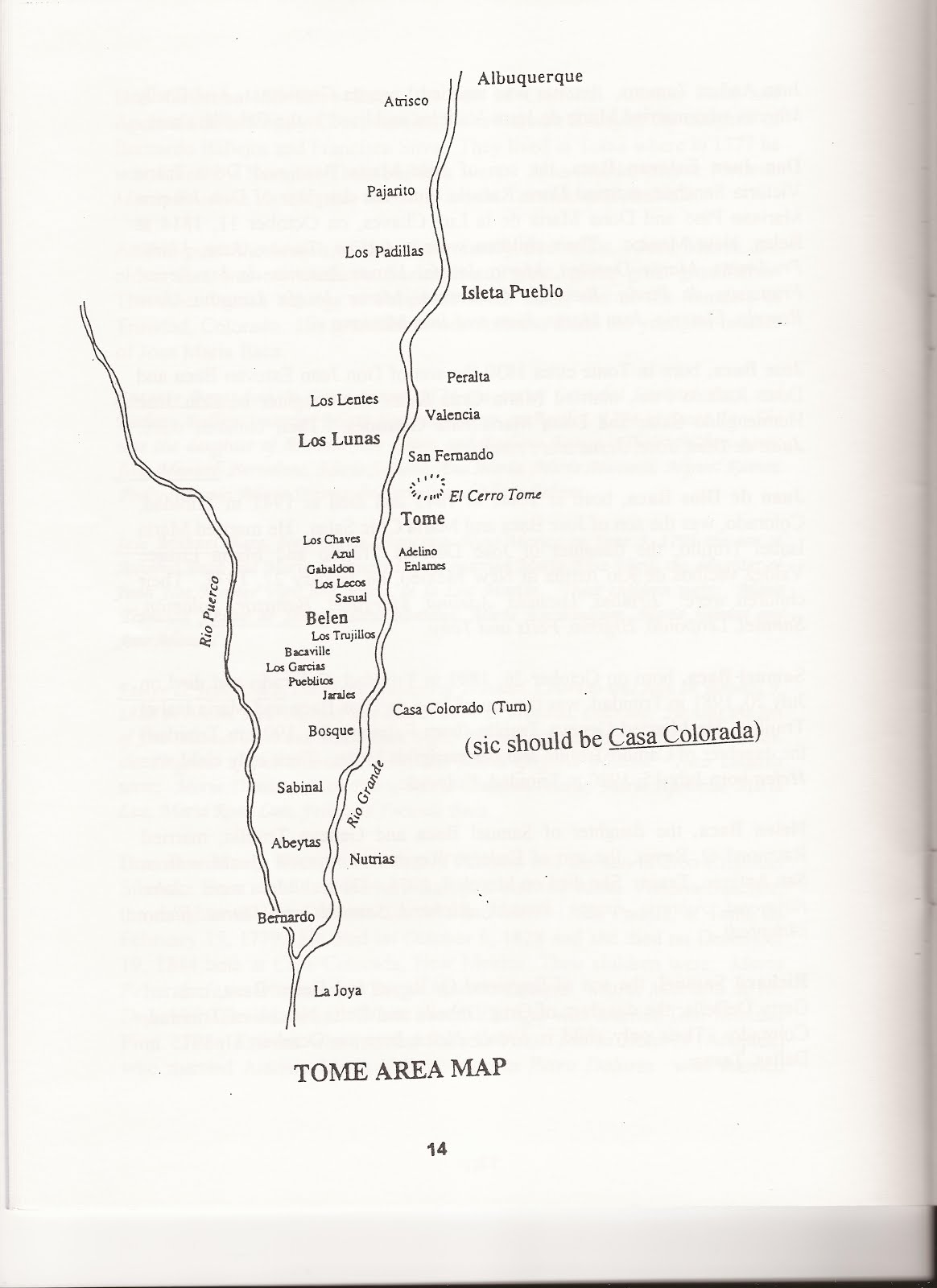
The image comes from the publication Herencia, The Quarterly Journal of the Hispanic Genealogical Research Center of New Mexico.
Monday, December 31, 2012
Before Mexico There Was New Mexico
 Click on the image to make it larger.
The areas labeled "foreign areas" were in reality the Spanish provinces of California, New Mexico and Texas. You can see that a lot happened in our history between 1820 and and 1846 when the Americans annexed this area.
New Mexico was New Mexico before Mexico became Mexico. Does that make sense? Well it should because New Mexico was called New Mexico way before the country of Mexico came into being in the early 1800's. New Mexico was New Mexico by the middle to late 1500's and Antonio de Espejo was the man historical records indicate first used the name for land previously called La Tierra Nueva.
New Mexico was New Mexico before Mexico became Mexico. Does that make sense? Well it should because New Mexico was called New Mexico way before the country of Mexico came into being in the early 1800's. New Mexico was New Mexico by the middle to late 1500's and Antonio de Espejo was the man historical records indicate first used the name for land previously called La Tierra Nueva.
You see what is now the country of Mexico used to be several provinces in New Spain when ruled by the Spanish. It was not until after the war of independence with Spain that the country of Mexico came into being. At that time the province of New Mexico in Spain became the department of New Mexico in the new Mexican Nation.
When the Americans took over the northern territory of Mexico (New Mexico), it was a lot larger and included all of today's state of Arizona as well as parts of Colorado, Utah and Nevada. New Mexico was partitioned and parts of it went into new American states. And what we have left is the Land of Enchantment we know today.
Saturday, December 22, 2012
Sentenciado A Hacer Adobes Or Sentenced To Make Adobes

The information cited in this post is gleaned from pages 305 and 306 of the document/publication "New Mexico Roots Ltd." written by Fray Anjelico Chavez.
Antonio was the son of Captian don Fernando Duran y Chavez and dona Lucia Hurtado. He was getting ready to marry dona Antonia Baca who was 15 years of age and from Bernalillo.
Antonio de Chavez requested a marriage dispensantion from the 3rd degree of consanguinity and the 2nd degree of affinity from illict coupla with the brides relative, later found to be related to him in the 4th degree. Reasons given for the dispensations were that the bride was very poor and in danger of losing her honor if her relatives died. The paudity of equal status in this "miserable kingdom" and the groom's own clarity for helping her besides his fondness.
The dispensation was granted with penalties, the groom had to labor manually one day a week for 4 months at the parish church and beg for alms for the poor souls. He had to donate 1,000 adobes for the Albuquerque church and the same for Bernalillo cemetary and he had to personally make 100 adobes for the Albuquerque Church and and 100 for the one in Bernalillo. He had to work personally for one whole week at each place so that others will be deterred from similar commissions.
The witnesses to this penality were the Albuquerque notary Juan de Dios Martin, Francisco Xavier Benavides , Sebastian Antonio Maldonado. Also withesses were the Bernalillo notary Jose de Quintana, Cristobal Arellano and Diego Montoya.
The pair were married on the 23rd of March of 1718 with the nuptial blessings being on April 24th of the same year. The witnesses to the marriage and the nuptial blessings were don Miguel de San Juan, Isabel Montoya and Ignacio de Aragon.
Sunday, December 16, 2012
Los Padrinos
My birth padrino and madrina were my mother's oldest brother Jose Benavidez and his wife Francisca Ortega. My first name at birth was my paternal grandfathers first name, Preciliano. That was it, no middle name. As it was told to me, at the baptismal the priest insisted I needed to have have a Christian name to go along with Preciliano, somehow the name Joseph came up. My padrino Jose probably did not mind and neither did my father as that was his fathers first name. So I ended up Preciliano Joseph instead of like my paternal grandfather, Jose Preciliano. Everyone must have been satisfied and that is what ended up on my baptismal certificate.
My padrino Jose was later to kill his ex wife Francisca in a domestic dispute gone bad. Francisca was a special friend of my mother's and she asked her nephew and their son, Damian, to be my conformation padrino. For some reason or other he ended up in the Navy and unable to be my sponsor at the confirmation ceromony. My mother then asked a distant relative who lived near by to be my padrino, he was Telesfor Archuleta.
My mother, Maria del Refugio Benavidez and Telesfor Archuleta were 1st cousins 3 times removed. Telesfor Archuleta and his wife Teresa Montoya lived across the railroad tracks from my grandparents. They had always been very close and I spent a lot of time at their house being spoiled by both of them. I used to end up at their house "con cara de hambre", as my mother used to say, and mention a particular food and it would appear at the following meal which I was expected to partake in. Cold water, tortillas, biscochitos, sopa and panocha were mine for the asking there. So when my mother suggested my "tio Telesfor" as my padrino for my conformation I jumped at the opportunity. And as such "tia Terisita" became my madrina. In reality, in my case, there was no madrina for the confirmation ritual, just a padrino.
By the time I got married, where there would normally be another set of padrinos, I had left the church and ended up with witnesses picked up at the presiding judge's office in Brighton, Colorado.
My padrino Jose was later to kill his ex wife Francisca in a domestic dispute gone bad. Francisca was a special friend of my mother's and she asked her nephew and their son, Damian, to be my conformation padrino. For some reason or other he ended up in the Navy and unable to be my sponsor at the confirmation ceromony. My mother then asked a distant relative who lived near by to be my padrino, he was Telesfor Archuleta.
My mother, Maria del Refugio Benavidez and Telesfor Archuleta were 1st cousins 3 times removed. Telesfor Archuleta and his wife Teresa Montoya lived across the railroad tracks from my grandparents. They had always been very close and I spent a lot of time at their house being spoiled by both of them. I used to end up at their house "con cara de hambre", as my mother used to say, and mention a particular food and it would appear at the following meal which I was expected to partake in. Cold water, tortillas, biscochitos, sopa and panocha were mine for the asking there. So when my mother suggested my "tio Telesfor" as my padrino for my conformation I jumped at the opportunity. And as such "tia Terisita" became my madrina. In reality, in my case, there was no madrina for the confirmation ritual, just a padrino.
By the time I got married, where there would normally be another set of padrinos, I had left the church and ended up with witnesses picked up at the presiding judge's office in Brighton, Colorado.
Wednesday, December 5, 2012
Long Day Trip over 5 Mountain Passes

Dry, very dry everywhere.
Went over a total of 5 mountain passes in New Mexico and Colorado, Palo Flechado Pass, Brazos Pass, Cumbres Pass, La Veta Pass and Raton Pass all in one day on this trip.
Tuesday, November 20, 2012
What Would Have Been the Result if New Mexicans had Resisted the American Invasion in August of 1846

New Mexican Governor Manuel Armijo
Think about it a bit. Make some calculated guesses as to what would have happened during and after the resistance if New Mexicans under governor Manuel Armijo had made an all out effort to resist the invasion by the Americans led by General Stephen Watts Kearny at the head of the American Army of the West. I am going to tell you that the result would have been a rout for the New Mexican defenders and a disaster for the survivors that would have remained as well as the rest of New Mexicans.
Other considerations for governor Armijo was the fact that there were a large number of Americans spies as well as pro American New Mexicans in the province. There was a lack, amongst New Mexicans, of guns, ammunition, food, discipline, drilled militia and finances to sustain a long drawn out war. Also, they could not count on Mexico City for reinforcements. All of this was known to governor Manuel Armijo and to Stephen Watts Kearny.
Governor Manuel Armijo also knew what Kearny had. How many horses, how many men and most important how many arms, and artillery. Armijo knew what the Americans could throw at the New Mexicans. It was a foregone conclusion to Armijo and to Kearny what would happen should New Mexicans resist the invasion.
A good portion of New Mexican men of fighting age would die in the effort. Armijo knew that and there is no doubt he took that into consideration. And we need to take into consideration the population of New Mexico at the time. It was about 40,000 Hispanic and probably not more than 10,000 Pueblo Indians. The non Pueblo Indians could not be counted as allies of the Hispanos or the Pueblos. Make an educated guess that out of 50,000 New Mexicans present 50% were women, 10% of the men would not be to participate because of advanced age and another 10% unable because they were too young and you get the picture. There would be fewer than 15,000 able bodied men capable of participating in a resistance to the American invaders.
Imagine an all out war in the defence of New Mexico with what we know. New Mexican male numbers would be reduced by 5,000 to 8,000 before they capitulated. The effect would have been a disaster to the province, a disaster to the Pueblo's and a disaster to Hispanic New Mexicans. The population of New Mexico would be changed forever. The people would be changed forever.
Governor Armijo knew that. He probably saved more New Mexican lives with the decision not to oppose the invasion than any other person, past or present.
Americans in New Mexico of the period were in reality spies, they had been carrying news back to the "states" of New Mexican strengths and weakness for over a quarter century. Americans were well aware that New Mexico and the northern part of Mexico were undefended and ripe for American expansionism.
Sunday, November 18, 2012
Mi Sobrina, Cinco Generaciones de Antepadados

Click on the image to make it larger.
The chart illustrates that the parents of Ursula Martinez have not been identified so far. Additional research is required to identify them.
Wednesday, November 14, 2012
More History of the Rowe, NM Area

With the coming of the Atchison Topeka, and Santa Fe Railroad in 1880, New Mexico truly entered the United States. Passing within a mile of Pecos Pueblo, the transcontinental line followed the same ancient route over the divide, hauling in thousands of cattle and hauling out tons of ore bearing precious metals that had eluded Spanish treasure seekers. The railroad also brought scores of American settlers, who laid their views of land ownership, government and culture over those of the area's Hispanics.
To exploit the tourist trade made possible by this influx, rodeo producer Tex Austin established a dude and cattle ranch in 1926. Dubbing his operation "Forked Lightning Ranch," Austin acquired 5,500 acres surrounding Pecos Pueblo in dealings both legitimate and shady. He converted the remains of the Kozlowski's Stage Stop into his ranch headquarters and hired John Gaw Meem - now famous for his "Pueblo Revival" style of architecture - to design and build the main ranch house on a bluff above the Pecos River.
Following Austin's loss of the Forked Lightning Ranch in bankruptcy, Texas oilman E.E. "Buddy" Fogelson purchased it in 1939. Ten years later, Fogelson married actress Greer Garson. Summering in the ranch house, they experimented raising Santa Gertrudis cattle at high altitude. The Fogelsons fell in love with the valley and their conservation work paved the way for the creation of the Pecos National Historical Park.
Saturday, November 10, 2012
The AT&SF Railroad Comes To Rowe, NM In The Summer Of 1880

Rowe was also a "brand new" town. The current residents having moved here from Las Ruedas and Los Trigos which were communities on the Pecos River and part of the Los Trigos Land Grant. Before the Atcheson Topeka and Santa Fe (AT&SF) Railroad there was no Rowe, New Mexico.
Folks moved here from the river communities for jobs on the railroad. There was money to be made making railroad ties. This was the primary occupation up and down the communities adjacent to the railroad tracks during that period.
The AT&SF was a part of the community for close to 100 years. Today all that remains is an Amtrak Train once a day in each direction. The AT&SF was bought out by Burlington Northern RR who used the tracks for a few years until the mid 2000's when it stopped using the tracks.
Soon, there will be no more trains through Rowe. The reason for it's original residents having moved here will now be gone. A lot of descendants of the original settlers still live in Rowe.
Subscribe to:
Posts (Atom)