Wednesday, June 14, 2017

Los Hermanos de la Sociedad de Nuestro Padre Jesus Nazerno, Rowe, New Mexico in the 1960's

A typical morada.

https://en.wikipedia.org/wiki/Penitentes_(New_Mexico)

There were 6 (six) of us if I recall right. There was don Jose Gutierrez who belonged at the morada in San Juan, New Mexico in San Miguel County. Esquipula Padilla belonged to the same morada.

Then there was don Pablo Salmeron who belonged to the morada in El Guzano (South San Isidro). He was the only member from Rowe there.

Myself, my brother and Nicasio Archuleta belonged to the morada in Las Colonias, San Miguel County. There were two moradas in Las Colonias, one near town and the other at "el Cerrito". We, form Rowe belonged to the one at el Cerrito.
Some hermanos in a morada somewhere in New Mexico

As illustrated by the above narrative, not all towns had a morada and some had more than one. I have no idea why, could have been politics, could have been the need/want to keep the numbers of hermanos to a manageable number. Anyway, Rowe did not have its own morada.

I recall my time with this group as one of the best times of my life, los Hermanos were the best of the best of the people in the area. It was one of the cherished things I left when my religious beliefs went "south".  Years later I ran into the Hermano Mayor and he told me my place at the morada was still there, waiting for me should I decide I wanted to rejoin the group..... but I would have to rejoin the Catholic Church and go to confession and receive the Eucharist before I could do that.

Today when I read about the "Penitentes" I do not recognize the folks some write about. We were a very private group and only members and families were ever invited to the morada and that was usually during Holy Week in Lent. The remainder of the year only members were present unless someone bought a "guest". Usually guests were cleared in advance. Our morada was very remote and 99% could/would not undertake the trek without some means other than walking.

Needless to say, I have never been back. But I do miss the morada, los hermanos and our get tohethers.


Tuesday, June 13, 2017

Genealogy, Never, Ever Complete......

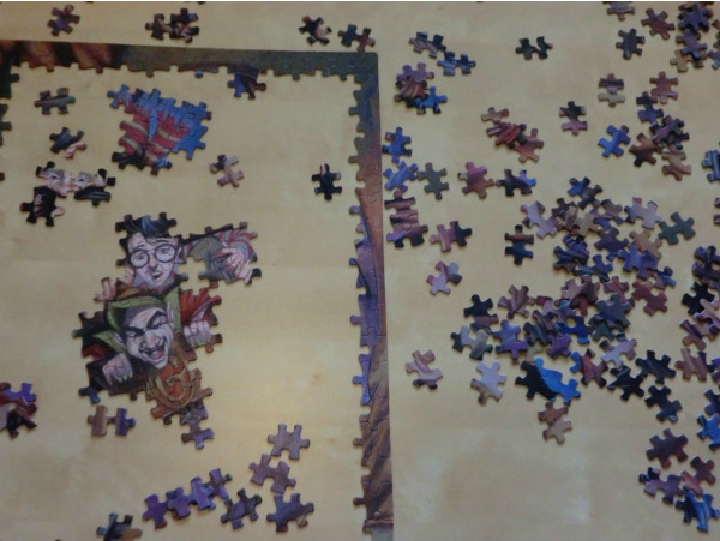
The genealogical puzzle is never ever complete, never. It is very interesting finding a piece here and there, but it is never really complete. It is the nature of the beast. Some pieces just fall into place, others not so much. Some mysteries are solved and others crop up as you look and find relatives. Some are destined never to be found.
Most genealogical charts are represented by the picture above, with a few known and many unknown pieces outside of the main picture. Some folks do not want to find certain pieces of the puzzle. Others, I am sure, omit certain known pieces that do not fit their narrative of "family".

To find a relative who was a crook or desperado 150 years ago seems not only ok, but to add some color to the tree. But the guy on the evening news who was drunk and killed several people in an automobile accident..... Well, some will eliminate or not add him to their tree because of this.

To find that GGGreat grand ma did something stupid may be ok, even funny on occasion, but not one close on the genealogical chart. Not mom or grand ma. They were saints and if you dare add it!!!!!

I have shared charts along with notes on the individuals in the chart that I happened to share. The notes contain some information on where the information came from and a short note on the individual(s) themselves.  Sometimes I have been asked to "clean" up the narrative and even been asked to get rid if "it" from my database. I will usually clean up the version I gave them, but my database remains as it is.

Sunday, May 7, 2017

La Cautiva Marcelina

Very interesting song:

https://vimeo.com/70437646

Sung by Virginia Bernal of Raton many years (1960's - 1970's) ago.

There were two (2) different women named Virginia Bernal who had ties to the Raton area, and were somewhat close in age. Not real sure that they were both in the area at the time the song was recorded.

One was born 25 January 1915 and died  9 August 2001 in Raton, New Mexico and came by her surname from her husband, Cristobal Bernal. I have not been able to find her birth parents.

The other one was the daughter of Juan Pablo Bernal and Teresina Lopez and was born 7 August 1920 in Tinaja, NM in Colfax County just a few miles from Raton. She died on 2 May 2002.

Both women had close ties to Tinaja and may very well been related by either blood or marriage or both.

I am not sure which one sang the song, it could have been either but most likely the first one noted here. She seems to have lived in the area when the song was recorded.

If you can help out, drop me a note and help out solving the mystery.

Tuesday, May 2, 2017

Identity Switching And Displacement And/Or Dissaperarance Of New Mexican Hispanos

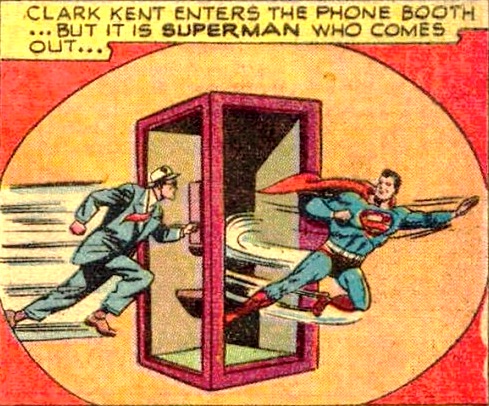
It happens folks, it happens all of the time and it happens a lot. It is happening more and more as we progress in time. I do not mean the multiple personality disorder either. I do not mean the Clark Kent and Superman type of identity switching. I mean New Mexican Hispanos wanting to be something they are not. The phenomena is not really new but it is accelerating at a pace that combined with other things happening with the demographics will cause New Mexican Hispanos to essentially disappear from New Mexico. I would guess that the process will be complete by 2099, that is about 82 years. I offer several examples;


  1. New Mexicans identifying as something other than New Mexican Hispanos. The number of folks wanting to identify as Jewish is probably the newest, the most common and the most numerous at the current time. There is no, I repeat no, evidence to substantiate this. But it has not, and probably will not, stop the trend. There are other New Mexicans identifying as someone else but nothing close to this new phenomena that started not long ago. DNA testing is no answer.
  2. Assimilation caused by intermarriage with non Hispanos. There is a lot of this and it started well before the American occupation when women were marrying French and later American trappers. It accelerated around Santa Fe and the Ft. Union area later when the Americans got here. The Las Vegas, Mora County, Taos and Santa Fe areas of the period attest to this.  Just look, even if casually, at the free 1880 US Federal Census.
  3. Immigration - We all know what happened here. We were over run, and I do mean over run by folks from "the States", non Hispanos from 1846 to the present. If you do not believe this look at the folks dying. I have seen days when not a single Hispanic out of 10 - 25 obituaries in both the Albuquerque Journal and the Santa Fe New Mexican were New Mexican Hispanic. Now there are even other Hispanos from other countries, mostly Mexico but others as well, who contribute to the decline of the natives.
  4.  New Mexicans leaving New Mexico - Even I left for over 20 years. I would venture a guess that over 1,000,000 former New Mexicans or their offspring live in states other than New Mexico. they left, never to return.
There is really nothing we can do, maybe nothing we ought to do, but you have to agree it is an interesting phenomena. It is happening and I may be off on the number of years till it comes to pass for sure, but there is no argument it will happen. New Mexican Hispanos will join the multitude of "Heinz 57" type folks out there that do not know or do not identify with their New Mexican roots.

Friday, April 7, 2017

San Viche Was Not A Saint, The Dangers Of Literal Translations

Reminds me of an article in the old La Herencia Magazine , a few years back they had a column there dealing with "Spanglish" and translated the old Spanish New Mexican saying "tu no saves que tantos trabajos he pasado" to "you don't know how many works I have passed". While literally I find nothing to disagree with the translation, it is way off the mark and way too funny.

My grand mother, who could speak no English, used to use the term "san viche" as an "epithet" or derogatory term, but in reality I think that was the extent of her knowledge of the real English (S.O.B.) term or what it really meant. But she was well aware that it was not a term designating a nice person or a saint.

There were so many ways to misunderstand and some of them were funny, there was always someone we knew who said something stupid because they could not "translate" and the process of learning English was difficult. I personally remember asking to "borrow the restroom" and some guy telling me that "sure you can borrow it, just make sure to bring it back." He thought it was funny and it took me months to figure it out why he did so.

Another friend of mine translated "esta caindo agua" to "it is falling water" when it was raining.

I remember a friend, Manuel Lucero, getting stopped in Pueblo, Colorado by the police and being asked for his drivers licence. He told the officer to "forget it" meaning that he had forgotten it. He was asked several times and he told them to "forget it" several times. It got him a trip to the station for some concocted offence. And in the early 1960's you did not want to get stopped by the police in Pueblo if you were a Mexican.

There were many and sometimes it caused me to remain quiet when I had something to say but was afraid I did not know how to say it.

Saturday, April 1, 2017

Family Lore, Oral Family History And Genealogy

It is almost worthless for genealogical purposes. There is too much embellishment by individuals who want to aggrandize one individual or another. The lure of wanting to be in the same group as one hero or another is too great to take oral histories into account as true history. It does have a way of working itself into it, but it decreases the value of the history. The truth is sometimes, no, not sometimes, almost always hard to live with.

Mediocre or nondescript lives do not make good for family histories. It is easy to add to, to embellish. It is almost too easy as other relatives chime in, also wishing to be in the glow of a heroic ancestor. it is equally easy to ignore faults, regardless of their magnitude.

It reminds me of obituaries.... They are interesting reading but not very accurate historical narratives of those being memorialized. They all went to heaven, all were taken by their lord, are now in the arms of other relatives and tip toeing through the proverbial tulips in heaven with their deity whom they served in a wonderful manner while on earth.

Here is previous post on this:

http://nuevomejicano.blogspot.com/2016/09/obituaries-keep-them-sane.html

You hardly ever hear anyone speaking bad of a departed relative... The Latin phrase "De mortuis nihil nisi bonum", it is best not to speak ill of the dead, seems to apply at these events. It seems no one wants to hear anything bad once a person dies, no matter what he or she actually was.

A personal story is appropriate here. In my youth, Don Ramon Roybal from Las Colonias, New Mexico was a great speaker, he was always called on to say a few words on behalf of the mourners at funerals. I recall a story that he once blamed the drunken habits of the husband and son for the untimely death of the mother and wife who lay in the coffin. Supposedly he said it in such a way that the true meaning came out only after discussions on the eulogy took place over a period of days.

There was an amusing article from a funeral up in Rio Arriba County where the priest supposedly indicated or insinuated that there was no way that the deceased was on his way to visit with St. Peter. No way the deceased would ever even see, much less approach, the pearly gates. The priest actually got sued and requested to retract his statement and apologize to the family.

By the same token, there are some extremely beautiful rememberances of some truely great people. The one below brings tears to my eyes and a lump to my throat.

http://nuevomejicano.blogspot.com/2015/01/manuela-mela-romero-1910-2011.html

Wednesday, March 8, 2017

Worthless New Mexican History!

The "southern" United States culture has always had a tradition of embellishment which goes beyond the ordinary.  They love the art of the "yarn" and never let a few facts get in the way of a good story. This goes to their historical observations and writings.

Early visitors from the United States to New Mexico were almost exclusively from the United States South, especially the "Show Me State" of Missouri. This has had a very detrimental effect on New Mexican history written by the first folks from the United States who wrote about New Mexico and New Mexicans. Documents contemporary to the period are at fault as are documents and narratives written later about someone by other than the persons being depicted in the narrative.

Reference the book "Uncle Dick Wooten" written by Howard L Conrad published originally by W.E. Dibble & CO. of Chicago, IL in 1890. The quotes attributed to Uncle Dick below are from there;

"I have observed in reading our frontier literature, that the tendency has been to exegerate and overdraw everything, and the effect of this has been, to give the Eastern public a wrong idea of the conditions which existed in this country (New Mexico and the early West), and the character of the men who found their way into these savage wilds in search of wealth and adventure."

Uncle Dick, as he was called, was to be later discredited by several other authors for some of the statements he made in the book referenced above.

Another reference to this embellishment comes from the book "When the Texans Came, Missing Records from The Civil War in the Southwest 1861 - 1862" written by John P. Wilson and published  in 2001 by the University of New Mexico press. Here it quotes from:

The Civil War history published as "War of the Rebellion: A Compilation of the Official Records of the Union and Confederate Armies" is also known as Official Records or OR. 

Lt. Colonel Robert Scott who supervised the historical project until his death in 1887 commented that "The experience of this office has demonstrated the utter unreliability of recollections of the war."

What are we to think of the historical narratives written about New Mexico and New Mexicans by some of the first folks who arrived here from the Unites States that were so unkind with their assessments of New Mexicans or what was happening in New Mexico in the period in question?

The prejudice and outright racist views that most of the early  visitors to New Mexico from the United States held is well known and well documented. This does not change the fact that this is where most folks get their information and where most folks establish their "first impressions".

That my friends is the problem......

The history books that have been written post 1970's are different and closer to the truth. I am talking here of legitimate history books, not the cowboy history some folks are still cranking out.

Tuesday, February 7, 2017

Curious New Mexican Habits in the pre American period.

New Mexicans had religious habits in the pre American period that were completely alien to Americans who arrived here early on. Not only were the Americans protestant but they had an innate hatred of Catholics, their priests and their religion. The best New Mexican historian of the period, Fray Angelico Chavez, alludes to this in one of this books , But Time and Chance, The Story of Padre Martinez of Taos, 1793 - 1867 published by Sunstone Press in 1981.

That being said, it is understandable that the historians made so many mistakes in their efforts to document the history of New Mexicans. I see these mistakes continually as I read even books written in the current period.

Some of the habits were unique and some were common to Hispanics, some common to Mexicans and some common only to New Mexicans. There was, or is, no real reason to expect or have expected protestants who were new to the area and who came with all of their hatred of New Mexicans and their ways to know these nuances that our ancestors had.

Only now, as documents are translated by New Mexican scholars can the real history be written. The book mentioned above written by Angelico Chavez is a perfect case in point. The picture that emerges of Padre Martinez is totally different than even modern "historians" like Paul Horgan painted. In reality and from a historical point New Mexicans writing their own history expose the inadequate efforts of previous persons.

Monday, January 23, 2017

Gabriel Chavez and Gabriel Chavez, What is up in the Chavez Household?

While looking at some genealogical information on an individual(s) we were having problems with, we had to dig deeper than normal to ascertain some facts that at first were confusing. 

The person we were having problems with was Gabriel Chavez the son of Jesus Chavez and his wife Ramona Garduno. At first glance we were confused because we could find children of Gabriel Chavez with what appeared to be two separate women. That in itself is not that unusual but things did not match up with Gabriel, his wives and children. 

Specifically, the marriage dates we found with the birth dates of the children of Gabriel Chavez and either of the women he was listed as having been married to. One was Cecilia Madrid whom Gabriel married May 17, 1874 in Anton Chico, New Mexico, the other was Porfiria Lucero whom Gabriel married on September 3, 1877 at Las Colonias, New Mexico.

At first look it appeared that the first wife, Cecilia Madrid, had died and Gabriel remarried to Porfiria Lucero and continued having children with Porfiria Lucero. But looking forward there appears a birth entry for December 25, 1890 for an Ignacia Chavez, the legitimate daughter of Gabriel Chavez and Cecilia Madrid. Now Christmas presents being what they are, a daughter with a former wife while the current wife is still alive does not fit into a proper Roman Catholic household of the period we were looking at. 

Looking still more we found an entry for the woman whom we thought had passed away, Cecilia Madrid, marrying an individual by the name of Elizario Crespin on October 29, 1896 in Anton Chico, New Mexico. This entry does not indicate that she was  a widow, it is a simple entry listing the groom his parents and her name as well as her parents. But divorce and remarriage by the Catholic Church was not an option open to believers, So we had to believe that Gabriel Chavez had passed away sometime before.

So what was the situation with Cecilia Madrid, it could not have been a divorce as the church does not remarry divorced individuals. And she was remarrying and Gabriel was already married to Porfiria Lucero. Could Gabriel be seeing his ex, now remarried, and continuing to have children with her?

The solution came when we started scouring the U.S. Federal Census.

The screen grab below is from the 1870 U.S. Federal Census for "Las Colonias de San Jose in San Miguel County, New Mexico. It lists the household of Jesus Chavez and his wife Ramona Garduno de Chavez. You will need to click on the image to make it larger.
Click on the image to make it larger

Mr. Jesus Chavez and Mrs. Ramona Garduno de Chavez had at least five (5) different children and for whatever reason the second child was named Gabriel and the fourth Jesus Gabriel. Again, this giving the same name to different children was not really unusual in New Mexican history  It was used frequently when the first child passed away. The next child born might be named in the honor of the recently deceased child.

But this was not the case here, both children survived well into adulthood and both married and both had children. The problem came when they were both listed simply as Gabriel Chavez in the church records. it would be my guess that in the village one was known as Gabriel and the other as Jesus.

The church records made a mystery where none really existed. But to the individual following the individuals a over a century later the situation required looking around to figure it out.

Wednesday, December 28, 2016

New Mexican Patriots or Horse Thieves and Murderers in August of 1847

This post is about the drumhead court martial incident that came to be known as The Las Vegas Affair or the Battle of Las Vegas, which  was a battle associated with the Taos Revolt and fought in July of 1847 in and around Las Vegas, New Mexico. It was initiated by American troops against New Mexican insurgents at the town of Las Vegas during the Mexican-American War.

Some information can be found at the web links below:

http://www.kmitch.com/Taos/martialdeaths.html

and

https://en.wikipedia.org/wiki/Las_Vegas_Affair

and at this one below. At this last location scroll down to page 60 otherwise you have to go through the whole magazine.

http://nmsantos.com/archive/TR57.pdf

Several men were hung as a result, the ones hung in Santa Fe on the 3rd of August of 1847 are listed below. Note: The three (3) Martín brothers executed were my relatives.

Jose Tomas Duran also known as Tomas Duran Y Chavez who was married to Maria Donicia Blea. Tomas was the son of Juan Jose Duran and Juana Francisca Montoya and left one small child as well as one on the way that his wife would give birth to on the 8th of November of 1847.

Note that Maria Donicia Blea and the three Martín brothers noted below were first cousins, all four grandchildren of Juan de Jesus Blea and Maria Matiana (Mariana) Moya.

George Rodriguez, I have not bumped into any information on George.

Manuel Saens, some information on Manuel, but nothing that I can substantiate at this time.

Pedro Esquipula Martín was baptized on the  16th of  December 1817 in San Miguel del Bado, New Mexico by his padrinos Jose Maria Romero and Antonia Corina de los Angles. His parents were Santiago Martín and Paula Blea. Pedro married Maria Getrudis Trujillo on 02 October 1842. Her parents were Juan Antonio Trujillo and Rafaela Ocana.

Pedro Esquipula Martín left a very young widow. He himself was just shy of his 29th birth date when he was tried, found guilty and executed by the Americans.

Jose Policarpio (Carpio) Martín was born and baptized on the same day, 26 November 1818 in San Miguel del Bado, New Mexico. His padrinos were Jose Rafael Baca and Maria Guadalupe Gallego. His parents are identified as Santiago Martín and Paula Blea.

Carpio, as he was known, was either single as I have found no marriage record nor other records that would indicate that he was married. He was just shy of his 28th birth date on the fatefull day of his hanging.

Jose Dionicio Martín was baptized on 11 April of 1845, his padrinos were Jose Duran and a woman named Gertrudes, last name unknown. His parents are identified as Santiago Martín and Paula Blea, He was not married that I know of and was just past his 22nd birth date when he was executed along with his two brothers and Tomas Duran who was married to his first cousin.

Monday, December 5, 2016

The Old New Mexico And Our Ancestors, Caught In A Time Warp

Alvar Nunez Cabeza de Baca. Andres Dorantes de Carranza, Alonzo del Castillo and Esteban de Dorantes started the journey through time in New Mexico in the late 1530's. They were the futuristic Spanish explorers in the vanguard of the new world exploration.

They were soon followed by Fray Marcos de Niza and once again Esteban de Dorantes in 1539. In 1540 Francisco Vasquez de Coronado followed de Niza north into New Mexico and beyond.

Vasquez de Coronado came to New Mexico and points north, east and west into what is now the American states of Texas, Kansas, and Arizona. A whirlwind of activity, exploration, battles and disappointment until he left in 1542.

A few other Spaniards and Spanish expeditions in the following years penetrated into New Mexico for various reasons. But the settlement and the end of the futuristic expeditions was initiated by don Juan de Onate in 1598. New Mexico was entering the time warp without even knowing it. 
In the he Onate era and the following 212 years, through 1810 or so, New Mexico and New Mexicans slipped further and further back in time to the point that they adapted to and adopted much of the Pueblo Indian way of life. Abandoned by Spain in the northern most province of the Spanish Empire with no access to the sea and thus no real access to the outside world. New Mexico was landlocked with no access to new technology or ideas.


In the 1810 to 1846 era the future started arriving in the form of traders and fur trappers trappers first from France then from the new nation of the United States. It was slow at first and exploded into the open with the expulsion of Spain from the New World and especially New Spain which included New Mexico.

In the late 1820's the Mexican Republic was born and its northern most province, New Mexico, opened its borders to the future in the form of traders and trappers from the United States. The future came rushing in.  By ones and twos at first and soon whole trains of Americans. It was not good or bad, but it was the future and the rush was on.

Then 248 years after the entrance into the time warp by don Juan de Onate came August of 1846 and the future in the form of the American Army of the West was here. General  Stephen Watts Kearny took possession of New Mexico in the name of the United States.
The rest, as they say, is history. The struggle of the Onate Colonists and their descendants to adapt, this time to the future. Mind you, there are a few more details and individuals in the interim. But for all intents and purposes, this is it.

Saturday, December 3, 2016

¿Quiten se las como puedan?

¿Quiten se las como puedan? The true meaning lies somewhere between "tough, you figure it out" or "that is the way it is". It means you are alone to figure out your problem. There is no help to be had. It was an old New Mexican saying from antiquity.

People are looking for meaning in their lives, looking for assistance from someone, anyone. Or so it seems. They look to religion, they look to government, they look to religious or governmental institutions to alleviate their search for meaning in their lives. They look anywhere and everywhere and seem to find other like minded individuals to form some kind of a group. Looking for fellowship or some other synonym.

Being alone or having idea(s) that only you seem to have is uncomfortable for most. So we look for others who seem to share our joyous or miserable condition(s).

The quest will never end......

Saturday, November 26, 2016

Adios

Adios Fidel

Friday, October 7, 2016

Buying into New Mexican History

You want to buy into New Mexican history, marry a New Mexican or someone with New Mexican roots. That is all it takes. New Mexicans are intricately tied to the history of the area by the blood relationships that developed with living in near isolation from 1598 to 1846. That is 248 years folks, by comparison New Mexico and what was then new Mexico has only been part of the United States since the occupation by the Americans in 1846, that is only 168 years. A small population isolated for that long a period of time become tied together in all sort of ways.

Every hero and every crook of the pre American period is related to us. Related by blood, a bit distant maybe, but all related. Even the "old" Anglos, the trappers, early soldiers and traders as they all married into the New Mexican families. We all know who they are. Their names are salted through New Mexico like pepper on an egg white.
Some folks may not want to be a part our history, some may want to deny it. But in all reality it is there, like it or not. And, this is a big AND.... It is interesting.

Friday, September 23, 2016

Como Se Llama La Cosa Mala?

The names of evil in Mew Mexico, at least as I recall them! 

Como se llama "la cosa mala"?

Satanas? Satan? The name was used regularly.

El Diablo? Very much used, some odd folks were actually called Diablos or Diablitos.

Asmodeo? Ascually a name for the second in command in the nether regions. Was a character in the play of "Los Pastores".

La Cosa Mala? Literally the "bad thing". I don't really know why this was used as much as it was. It used to give me the creeps.

El Angel de la Muerte? The angel of death. Usually had a dark hoodie on. Came around on occasion, the folks he took always were delivered to heaven. He was the delivery man for St. Peter.

El Demonio Colorado? Literally the red demon. Remember the "Demons" in Santa Fe? The Santa Fe High School Demons. The St. Mikes Horsemen and the Santa Fe Demons were traditional rivals. Funny if you think of the whole name "the city of holy faith demons".

Thursday, September 22, 2016

Historical Writing, From Cuneiform And Cave Drawings To Facebook. Why Was It Written As It Was And/Or Is?

Ask yourself the question! Why was it written? What was the objective of the writer? What were the writers goals. Actually these questions can be asked of novels and historical novels and even just plain articles, webposts and Facebook posts. Some publications can be deciphered pretty quick as to motives for having been written, others not so mush. Especially when written as "serious history"!
So why were the publications listed below written?

Commerce on the Prairies? It was meant for publication. Why does that make a difference? Well Josiah Gregg had a reason for writing the book. All you have to do is read it and seriously ask yourself the question.

Sears and Roebuck catalog? Was or is it historical? It is used as a historical publication on occasion. Both Sears and Roebuck had their reasons for publishing the catalog. Sales, profit in their pocket was the reason.

Blood and Thunder? The "role" played by Kit Carson in the conquest of the Navajo. Why was it written? To make Kit Carson and his story heroic and maybe make it into a movie.

Cave drawings? You think the person drawing them was looking for fame or hero hood? I think not.  The individual was just bored and drawing something that came into his mind. Don't let the archaeologists fool you, they do not know any better than you or I why they were drawn.

The Lost Pathfinder? The travels in the southwest by Zebulon Montogomery Pike. A pretty good historical account of Pike's travels in the area. Remember it was written by someone else using his dispatches back to the American government.

Decision Points? Written about George W. Bush about George W. Bush. Take a wild guess as to why it was written.

My life? Written by Bill Clinton about Bill Clinton.... Take a guess about the reasons for this "historical" account.

Rousseau and Revolution? Written by Will and Ariel Durant. Read it and find out.

Death Comes to the Archbishop? Written by Willa Sibert Cather. She wanted to destroy the heroic image New Mexicans had of Padre Jose Antonio Martinez. Sad to say she did a bang up job of it too.

Modern day newspapers? Take a guess why they are written the way they are.

Facebook posts? Puckered lips and all, like some crazy teen?

Well I hope you get the picture. Books in general and historical books in particular are written for a reason. Most times, the truth be told, there is an ulterior motive, sometimes sinister or injurious to someone or something.

The bottom line is look for the motive behind the writing, it is there. You do not need to be a Sherlock Holmes to figure it out. But you do have to look for it.

Friday, September 16, 2016

What Is In A Name?

Maria Preciliana Telesfora de Jesus Maria y Jose Salazar. Quite the moniker if I do say so myself. Preciliana, as she was known was born the 4th of January in 1827 in Tome, New Mexico to Jose Antonio Salazar and Maria de la Luz Jiminez.

Her baptismal or given name even had two (2) Maria's.

Preciliana married a man by the name of Jesus Maria Luna, the son of Jose Enrique Luna and Juana Maria Gabaldon. Preciliana and Jesus had one son, Patrocinio Luna born on the 9th of November on 1843. Jesus Maria Luna died right around the time his son was born as Preciliana was remarried on October 26 1845 to husband number two, a guy named Jose de Jesus Romero with whom she would have at least an additional four (4) children.

So she Married 1) Jesus  Maria Luna and 2) Jose de Jesus Romero.

Notice that she and her first husband shared two names Jesus and Maria. With her second husband she shared another two names Jose and Jesus.

This naming of folks after the "holy family" and especially the "savior" himself really upset Americans as they started the occupation of the New Mexico. The Protestant  religious leaders that came in as the occupation took hold saw this as sacrilegious. This was especially true if the guy was named Jesus and was an idiot, or worse, some type of a criminal.

Everyone, or so it seemed, was named either Jose, Maria, Jesus, Juana or all of the above.

Time wise, we are a ways from that now that everyone is assimilated to the degree that we are. I do not think we will see anyone like Preciliana anymore.


Saturday, September 10, 2016

Another Genizaro, Named Francisco Valdez.

By the time Francisco came into Hispanic New Mexico, the term Genizaro was no longer used. More than likely the softer term "criado" was used. The term Genizaro was banned for use to describe individuals after New Mexico passed from Spanish control to Mexican control. The Mexicans did not appreciate the caste system which had developed under the Spanish. Mind you the effect and the situations were identical. To the individual it mattered little what term was actually used.

We know what happened to Francisco, we don't know exactly where he came from. The best information we have is that he was Apache born in the Navajo country. He may have been Navajo. He was purchased, or somehow ended up in the family of Antonio Jose Valdez and his wife Maria Antonia Quintana originally from Taos but later from Rayado in Colfax County, New Mexico. The best information I have is that Antonio Jose Valdez and his wife, Maria Antonis Quintana had twleve (12) children of their own.

So Francisco's children are 1/2 Native American and his grand children at least 1/4. As to what tribal group Francisco was taken from we can only guess. Family information has it that Francisco knew he had a sister, whom he never saw again after being taken form his family and homeland.

We know that Francisco survived the ordeal and actually thrived. He has many descendant around today in Northern New Mexico and Colorado.


Some Descendants and Families of Francisco Valdez

1. Francisco Valdez  was born about March 1858 in Navajo Country. He died on 22 December 1927 in Miami, New Mexico. He was buried in Agua Dulce (Miami), New Mexico.

Francisco married Marina Coca  on 26 November 1880 in Cimarron, Colfax County, New Mexico, the daughter of Isidro Coca and Refugio Lucero. Marina was born in January 1861 in New Mexico. She died about 1897 in Blanco, New Mexico.

They had the following children:

+ 2 F i. Benina Valdez  was born in Deccember 1881 and died about 1969.

+ 3 F ii. Salome Valdez  was born on 22 October 1883.

4 M iii. Guillermo Valdez  was born on 10 February 1887 in New Mexico and died on 11 May 1972 in New Mexico.

Guillermo married Cecelia Sanchez .

5 M iv. Jose Damian Valdez  was born on 18 November 1890 in New Mexico.

Jose Damian married Adela Aguilar, the daughter of Aurelio Aguilar and Carolina Ortega on 8 November 1910 in Springer, New Mexico. Adela was born in 1895 in Springer, New Mexico.

6 M v. Pedro Jose Valdez  was born on April 1892 in New Mexico.

7 F vi. Adelaida Valdez  was born on March 1895 in New Mexico.

8 M vii. Francisco Valdez  Jr. was born on 22 September 1897 in Rayado, New Mexico. He was buried on 12 November 1988 at the Fairmont Cemetery in Raton, New Mexico.

Francisco Valdez Jr. married Maria Soledad Aguilar  daughter of Aurelio Aguilar and Carolina Ortega on 7 October 1918 in Springer, New Mexico. Maria was born on 14 March 1899 in Rayado, New Mexico. She was buried in 1991 in the Fairmont Cemetery in Raton, New Mexico.

9 M viii. Jose Gabriel Ventura Valdez  was born in July of 1899 in New Mexico.

Jose Gabriel Ventura Valdez married Magdelena Montoya  in Springer, New Mexico.

10 F ix. Refugio Valdez  was born about 1903 in New Mexico.

Refugio Valdez married Santiago Felipe Aguilar, the  son of Aurelio Aguilar and Carolina Ortega on 3 September 1920 in Springer, New Mexico. Santiago was born about 1902 in New Mexico.

11 F x. Delfina Valdez  was born about 1903 in New Mexico.

Delfina Valdez married Jose Isaiah Montoya .


Francisco's Grandchildren And Their Families

2. Benina Valdez  (Francisco) was born in December 1881 in New Mexico. She died about 1969.

Benina Valdez married Jose Ignacio Herrera  son of Juan Nepomuceno Herrera and Maria Cecilia Martín on 20 June 1900 in Springer, New Mexico. Jose Ignacio was born on 3 July 1871 in Santa Gertrudis, Mora County, New Mexico. He was christened on 10 July 1871 in Santa Gertrudis, Mora County, New Mexico. He died on 7 August 1935 in Cimarron, New Mexico.

They had the following children:

12 M i. Candido Herrera  was born about 1901 in New Mexico.

13 M ii. Santiago Herrera  was born about 1904 in New Mexico.

14 M iii. Juan Herrera  was born about 1906 in New Mexico.

15 M iv. Francisco Herrera  was born about 1908 in New Mexico.

16 F v. Marina Herrera  was born about 1910 in New Mexico.

17 F vi. Mary Ann Herrera .

18 F vii. Ramona Herrera .

19 F viii. Eloisa Herrera .

3. Salome Valdez  (Francisco) was born on 22 October 1883 in Springer, New Mexico. She was christened on 15 November 1883 in Springer, New Mexico. She died in Trinidad, Colorado.

Salome Valdez married Sabino Deciderio Casias  on 3 February 1906 in Springer, New Mexico. Sabino was born in October 1882 in New Mexico and he died in Colfax County, New Mexico.

They had the following children:

20 F i. Maria Ferminia Casias. born on 30 April 1905 in Cimarron, New Mexico. She died on 31 August 1964 in Denver, Colorado.

Maria Ferminia Casias married Pedro Alfonso Pina . Pedro Alfonso was born on 23 July 1891 in Trinidad, Colorado. He died on 27 January 1952 in Denver, Colorado. He was buried in Mount Olivet Cemetery in Denver Colorado.

21 F ii. Teodora Casias  was born on 4 May 1907 in Los Montecitos, New Mexico. She died on 7 March 1996 in Cimarron, New Mexico.

Teodora Casias married Felipe LeDoux . Felipe was born on 3 December 1899 in Agua Dulce (Miami), New Mexico and he died about 1950 in Trinidad, Colorado.

22 M iii. Pablo Casias  was born on 22 September 1909 in Agua Dulce (Miami), New Mexico. He died about January 1972.

Pablo Casias married Juana Gonzales  on 16 April 1933 in Springer, New Mexico. Juana was born in 1918 in Levi, Mora County, New Mexico.

23 M iv. Marcelino Casias  was born about 1911 in Cimarron, New Mexico.

Marcelino Casias married Linore Montoya  in Springer, New Mexico. Linore was born in Mora, New Mexico.

24 F v. Leonora M. Casias  was born about 1913 in New Mexico.

25 M vi. Desiderio Casias  was born on 7 November 1914 in New Mexico. and he died on 2 February 1983 in Trinidad, Colorado.

26 M vii. Eloy Casias  was born on 20 June 1917 in New Mexico. He died on 20 Oct 1990.

27 F viii. Elena Casias  was born about 1926 in New Mexico.

Here are additional posts on the matter of Genizaro's;

http://nuevomejicano.blogspot.com/2010/03/say-it-loud-i-am-genizaro-and-proud.html

Sunday, September 4, 2016

Obituaries, Keep Them Sane

Obituaries, remembering the dead. Some observations as I pay attention to them more and more. Here is a doozie I was looking at the other day: 

He srved in the United States Army, was a pilot, a dedicated Christian and father, a family role model, a high school basketball state champion. 

Boxer/fighter, a mountaineer, a chef, a negotiator, a musician, a singer whom did it "My Way", an educator/teacher/tutor, a philanthropist, a savior for the poor children, an avid golfer, (two) hole-in-ones, and finally, simply a gem, He will be missed as he had a zest for life, yet will not be forgotten.


They forgot to add his walking on water.  He was not humble that is for sure, or those remembering him were very, very proud of his accomplishments! I assume that with all of these qualities he ended up at the pearly gates to find Jesus and his dad, St. Peter and Mary all clapping as he went through.

My advice is to keep it simple, the dearly departed is gone, we should in all reality leave the aggrandizement to others as they remember them. Like my grandfather used to say, "vive cuando vivo y cuando toca la muerte, muere te!" Live when alive and when death knocks, die!

The very best obituary was for a distant relative Mela Romero, I posted about it at the weblink below. That was a tribute that is hard to beat. I never met Mela but can admire a woman who was so well thought of by others.

http://nuevomejicano.blogspot.com/2015/01/manuela-mela-romero-1910-2011.html

Friday, August 26, 2016

Brand Spanking New Information On The Assination Of Governor Charles Bent

Governor Charles Bent

Some interesting information my wife and I discovered while doing our research on my family.

The assassination of Governor Charles Bent on the night of 19 January 1847 was a complicated affair carried out by some New Mexicans and Taos Indians, heroes and patriots all of them. The actual killing was gruesome, as are all killings, but it was an assassination.  The guy, Governor Bent, ended up dead and it was called a murder, but he was assassinated by New Mexican patriots. Make no mistake about it.

The Buenaventura Lobato and Mrs. Juana Catalina Valdez-Lobato mentioned in the article by E. Bennet Burton, quoted below, and published in the book noted below are in all reality Buenaventura de Jesus Valdez, my 2nd cousin several generations removed, and his wife Juana Catalina Lovato.

Buenavuntura Valdez was born 31 Jannary 1789 in Pojoque, New Mexico to Pedro Antonio Valdez y Bustos and Maria Manuela Gonzales. 

Mrs. Juana Catalina Valdez-Lovato was in reality Buenaventura's wife. She was Juana Catalina Lovato, born circa 1798, the daughter of Antonio Jose Lovato and Maria Josefa Chavez. Juana Catalina Lovato was the mother of  Maria Paula Lovato born 28 December 1811 in Taos. The birth of Maria Paula occurred when Juana Catalina Lovato was single.  Juana Catalina Lovato's daughter Maria Paula later married Charles Hipolyte Trotier Beaubien and was the mother of Narciso Beaubien who was also killed that fateful night.

So a short explaination is in order, Buenaventura de Jesus Valdez who the article states that in a public speech, afterwards admitted his local leadership in the uprising was married to the aunt of Narciso Beaubien, Juana Catalina Valdez. It is fair to assume that if Charles Hipolyte Trotier Beaubien, Narciso's father and husband of  Maria Paula had been in Taos at this moment, he would have been killed too.


In a book titled "Old Santa Fe, A Magazine of History, Archaeology, Genealogy and Biography" Volume 1, 1913 - 1914 published quarterly by the Old Santa Fe Press, Santa Fe, New Mexico and edited by Ralph Emerson Twitchell on pages 176 - 209 there is an article by E. Bennett Burton in his paper "The Taos Rebellion" mentions a Buenaventura Lobato and a Mrs. Juana Catalina Valdez Lobato as follows;

The massacre at Taos was under the leadership of Pablo Montoya and Tomasito, a Taos Indian, the last named, with a murderous band, going to the home of Governor Bent and while engaging him in conversation through the closed door, fired, striking him in the chin and stomach. The door was then broken in and the Indians filled the body of the fallen man with arrows, three of which he pulled from his head and face as he lay prostrate. As the Indians were slashing his wrists and hands with their knives and axes, a Mexican named Buenaventura Lobato entered the room and seeing what they were doing, cried" "I did not tell you to kill him, but only to take him prisoner!" Lobato, in a public speech, afterwards admitted his local leadership in the uprising. Governor Bent was scalped before he died.

In the meantime, seeing that resistance was useless. Mrs. Boggs, the wife of Thomas Boggs, Mrs. Carson and Mrs. Bent, all members of the governor's household, began to dig a hole in the adobe wall of the room, using an iron spoon for the purpose, hoping to enable the governor to make his escape. Though too late to save him, they were able to make their own way into the adjoining house. They were pursued, and Mrs. Boggs and Mrs. Carson begged on their hands and knees that the assailants spare the lives of Mrs. Bent and her children. This the murderers permitted, and the three women and the Bent children escaped to the home of Mrs. Juana Catalina Valdez-Lobato, where they remained until the arrival of the troops from Santa Fe fifteen days later.

More information on Governor Charles Bent at Wikipedia below:

https://en.wikipedia.org/wiki/Charles_Bent
NOTE: If anyone is interested in the genealogical information or sources leave a note and email so I can respond.